

TEEN ANXIETY THERAPY | SAN DIEGOHelping Overwhelmed Teens Feel More Confident, Capable, & In Control

When anxiety starts affecting school, friendships, confidence, or daily life, therapy can help.
Many parents tell me, “I wish we had started sooner.”
Reaching out doesn’t mean you’ve failed; it means you’re doing something different.
Does Any Of This Sound Familiar?

✓ Constant overthinking
✓ Fear of failure
✓ School stress
✓ Perfectionism
✓ Social anxiety
✓ Trouble sleeping
✓ Emotional shutdown
✓ Avoiding situations
✓ Panic or overwhelm
You may feel like you’re walking on eggshells, constantly reassuring them, or wondering why nothing seems to help.
You’re not alone.
Teen Anxiety Doesn’t Always Look Like Anxiety

Irritability
They seem angry, annoyed, or easily frustrated.

Isolation
Withdrawing from friends, family, or activities they used to enjoy.

Perfectionism
A fear of mistakes and overly high expectations.

Low Confidence
Struggling with self-esteem and feeling not good enough.

Academic Pressure
Overwhelmed by school, grades, tests, and future expectations.

Emotional Outbursts
Big emotions are often a child’s way of communicating overwhelm.
Does your teen get upset over small mistakes, avoid challenges, or constantly seek reassurance? Anxiety and perfectionism often go hand in hand. Read Anxiety and Perfectionism in Kids to learn what parents should watch for.

Physical Symptoms
Stomachaches, headaches, nausea, fatigue, or trouble sleeping.
What Teens Learn In Therapy

✓ Manage anxious thoughts
✓ Handle stress more effectively
✓ Build confidence
✓ Improve emotional regulation
✓ Develop healthy coping skills
✓ Feel more comfortable being themselves
In sessions, teens can:
Talk honestly with someone who won’t freak out, judge, or take sides.
Understand what they’re feeling instead of going straight to shutdown or blow-ups.
Build tools for stress, anxiety, friendships, school pressure, and family conflict.
Explore who they are - values, identity, and what matters to them without pressure to have it all figured out.
Many teens open up more easily to someone outside the family.
The skills they build in therapy make it easier for them to communicate with you at home.
TEEN THERAPY + PARENT SUPPORTParent Support Is Built Into The Process

Teens need privacy, but parents still need support.
While therapy gives your teen a space to talk openly and build confidence, you'll also have opportunities for guidance, answers to questions, and practical strategies you can use at home.

Regular Parent Check-Ins. Typically every 4–8 weeks, especially early on.

Guidance For Home Support with communication, boundaries, conflict, and school concerns.

Additional Support When Needed Parents are always welcome to schedule extra sessions.
When parents feel supported, teens tend to make progress faster.
Parents have shared that having their own individual parent coaching is incredibly valuable to help them navigate this tricky time in your teen’s life and help you reconnect, reduce conflict, and feel more confident navigating challenges at home.
I wrote a blog to help parents who feel they have tried everything with their teen and feel nothing is working with some tips for you to try. You can read ithere.
In the heat of the moment: what helps and what backfires
Do’s and Don’ts
What helps:
Take a breath and keep your voice as calm and steady as you can.
Lead with connection, not “winning” the argument.
Let them know you’re there and willing to listen, without forcing a big talk.
Reflect back what you’re hearing (“This feels really unfair to you”), even if you see it differently, to lower defensiveness.
Focus on listening, not fixing.
What backfires:
Pressuring them to talk before they’re ready when they’re already shut down.
Jumping straight into lectures, advice, or fixing.
Assuming distance means they don’t care.
Doubling down on control and monitoring when things feel out of control.
In therapy and parent sessions, we practice exactly what to say and do in these moments, so you’re not guessing or reacting on autopilot.
See more tips and tricks to help your teen here.


Hi, I’m Dr. Lindsay O’Shea

I’m a Licensed Clinical Psychologist (PhD) with years of experience helping kids, teens, and parents navigate big feelings, school stress, and family tension.
My approach blends evidence‑based therapy with real‑life tools - what to do when your teen slams the door, how to repair after a blow‑up, and how to set boundaries without constant power struggles.
I care deeply about helping teens feel seen and helping parents feel less alone and ‘in the dark’ in this season of parenting.
Dr. Lindsay can be reached at: (858) 381-0242
What To Expect

Step 1
We’ll discuss your concerns, your child’s history, and what you’ve already tried.
Meet With Parents


Step 2
Understand What’s Driving The Behavior
Together, we’ll identify the patterns, stressors, and underlying factors contributing to your child’s struggles.

Step 3
Build Skills & Confidence
Your child learns practical tools while you receive guidance to support progress at home.
Resources For Parents
Looking for practical parenting strategies? Explore articles on ADHD, anxiety, emotional regulation, school challenges, and raising resilient children and teens.



Frequently Asked Questions About Teen Therapy
-
Most parents reach out when they notice a clear change in their teen’s mood, behavior, or motivation and their usual tools aren’t working anymore.
You might consider teen therapy if:
Your teen seems more withdrawn, irritable, anxious, or overwhelmed than usual.
School, friendships, or family life are suffering.
You feel like you’re walking on eggshells at home or “missing” the kid you know is in there.
You don’t have to wait for a crisis. A brief phone consultation can help us sort out whether therapy for your teen in San Diego is the right next step right now.
I wrote to help you identify signs your teen may need additional help and offer suggestions about what you can try at home. You can read it here.
-
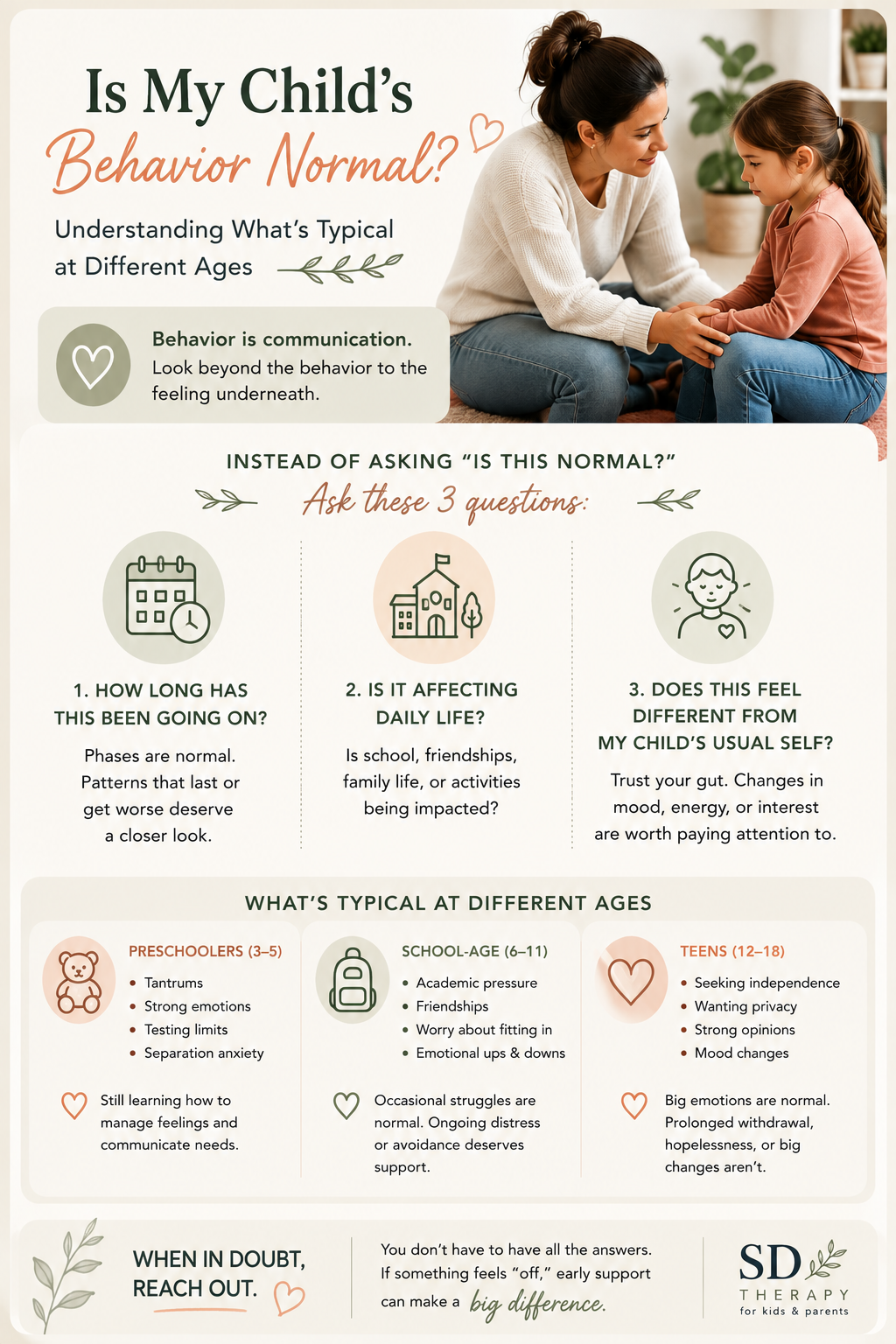
Some eye rolls, independence seeking, and moodiness are a normal part of teenage development.
I start to get more concerned when:
Your teen’s behavior is a big shift from their usual self
They’re withdrawing from friends, activities, or family
Emotions feel big, out of proportion, or hard to recover from
If you’re asking yourself this question, it’s already worth talking with a teen therapist. We can sort out what fits “typical teen” behavior and what may signify your teen could benefit from more support.
Book your free parent consultation here.
-
Yes.
Many parents are surprised to learn that anxiety often appears as irritability, frustration, emotional outbursts, or defiance. When teens feel overwhelmed, their nervous systems may shift into fight-or-flight mode, making anger more visible than fear.
Part of therapy involves understanding what's happening beneath the behavior.
-
Teen anxiety doesn't always look like worrying.
It can show up as:
Irritability or anger
Perfectionism
Avoidance of school or activities
Difficulty sleeping
Frequent stomachaches or headaches
Overthinking
Social withdrawal
Constant reassurance-seeking
Panic attacks
Many anxious teens appear successful on the outside while struggling internally.
-
Therapy helps teens understand what anxiety is, why it happens, and how to respond differently when it shows up.
Teens learn practical skills to:
Manage overwhelming thoughts
Calm physical symptoms of anxiety
Build confidence
Face fears gradually
Reduce avoidance
Improve emotional regulation
The goal isn't to eliminate anxiety completely - it's to help your teen feel capable of handling life's challenges.
-
Yes.
I work with teens experiencing anxiety, stress, perfectionism, emotional overwhelm, ADHD-related challenges, self-esteem struggles, social difficulties, school-related stress, and family relationship concerns.
If you're unsure whether therapy is the right fit, we can discuss your concerns during a free parent consultation.
-
Many parents come to therapy feeling exhausted, frustrated, or disconnected from their teen.
Therapy can help improve communication, reduce conflict, strengthen trust, and create a more positive parent-child relationship. As teens gain emotional skills and parents gain a deeper understanding of what's driving behavior, family interactions often become calmer and more connected.
-
Parent involvement is an important part of successful teen therapy.
While teens need privacy to build trust and speak openly, parents are often included through parent sessions, collaboration, coaching, and updates when appropriate. The goal is to help the entire family move forward together.
-
This is very common, and it doesn’t mean therapy can’t help. Many teens are unsure what therapy is, worry they’ll be judged, or feel like it means “something is wrong with me.”
Together, we can:
Talk about how to introduce the idea in a way that feels less threatening
Frame therapy as a space for them, not a punishment or “fixing”
Start with a low‑pressure first session where they can see what it’s actually like
Sometimes teens warm up over time once they experience being heard and not pressured.
You can learn more about how my approach helps kids and teens feel comfortable to open up here.
-
Most parents worry about this before starting.
Therapy with teens rarely looks like an interrogation. Conversations develop naturally over time through connection, curiosity, and trust. Many teens who initially say very little eventually become engaged once they feel comfortable and understood.
-
Every teen is different.
The length of therapy depends on your teen's goals, symptoms, strengths, and circumstances. Some families seek support around a specific challenge, while others benefit from longer-term work focused on emotional growth and skill-building.
These recommendations are discussed together during the consultation process.
-
Yes.
I work with teens experiencing anxiety, stress, perfectionism, emotional overwhelm, ADHD-related challenges, self-esteem struggles, social difficulties, school-related stress, and family relationship concerns.
If you're unsure whether therapy is the right fit, we can discuss your concerns during a free parent consultation.
-
The first step is scheduling a free parent consultation.
We'll talk about what's been happening, what's concerning you most, and whether teen therapy may be a good fit for your family. You'll have the opportunity to ask questions and learn about possible next steps before making any commitment.
-
Yes. Many children who struggle with anxiety also struggle with perfectionism. They may become extremely upset over mistakes, avoid trying new things, seek constant reassurance, or place enormous pressure on themselves to perform well. While these children are often described as hardworking or high-achieving, their perfectionism is frequently driven by worry, fear of failure, or fear of disappointing others. Therapy can help children develop healthier coping skills, build confidence, and learn that mistakes are a normal part of learning and growth.
Read Anxiety and Perfectionism in Kids to learn what parents should watch for.
Let's Figure Out What’s Really Going On

Dr. Lindsay O'Shea, PhD
Licensed Psychologist
✓ Child Therapy
✓ Teen Therapy
✓ Parent Coaching
You don’t have to keep guessing, second-guessing, or handling this along.
Whether your teen is struggling with anxiety, ADHD, emotional regulation, or challenging behaviors, we’ll work together to understand what’s beneath the behavior and create a path forward.