

Is My Child's Behavior Normal? A Psychologist Explains What to Look For
If you've ever found yourself wondering...
"Is this normal?"
You're in good company.
As a psychologist, it's one of the questions I hear most often from parents.
Maybe your preschooler has daily meltdowns.
Your elementary-aged child suddenly doesn't want to go to school.
Your once-chatty tween barely says two words after school.
Or your teenager spends every free moment behind a closed bedroom door.
It's natural to wonder:
"Is this just part of growing up?"
The answer is...sometimes.
Childhood is full of phases, big emotions, and developmental changes. Not every challenging behavior is a sign that something is wrong.
At the same time, it's important not to dismiss everything as "just a phase."
So how do you know the difference?
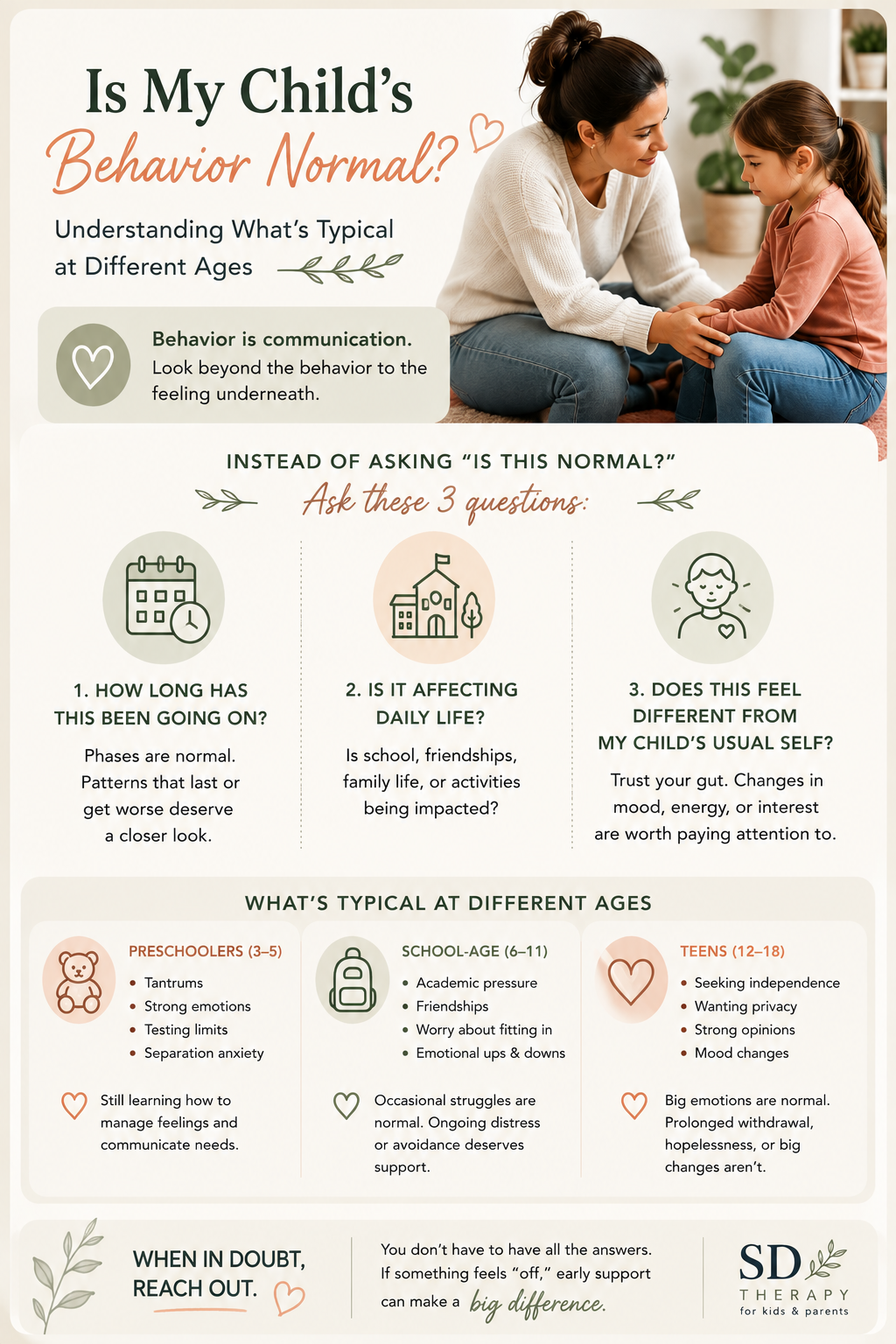
Instead of Asking, "Is This Normal?" Ask These Three Questions
Parents often focus on the behavior itself.
I encourage them to zoom out and look at the bigger picture.
When I'm meeting with a family, I'm usually asking myself three questions.
1. How long has this been going on?
Every child has difficult days—or even difficult weeks.
Maybe your child is adjusting to a new teacher, a move, or changes at home.
Those situations can temporarily affect behavior.
What I'm paying attention to is whether the behavior is improving over time...or becoming more frequent, more intense, or lasting much longer than expected.
Patterns are usually more important than isolated moments.
2. Is It Affecting Daily Life?
A child can have anxiety and still enjoy school, friendships, sports, and family time.
Another child may have anxiety that's preventing them from leaving the house.
The difference isn't whether anxiety exists.
It's whether it's interfering with everyday life.
Ask yourself:
Is my child avoiding things they used to enjoy?
Are friendships becoming more difficult?
Is school becoming a struggle?
Does our family feel like we're constantly walking on eggshells?
When emotions begin affecting daily functioning, it's worth paying closer attention.
3. Does This Feel Different From My Child's Usual Self?
Parents know their children better than anyone.
Sometimes it's not one specific behavior that raises concern.
It's simply the feeling that your child isn't acting like themselves.
Maybe they're quieter.
More irritable.
Less confident.
More emotional.
Or they seem to have lost interest in things they once loved.
I encourage parents to trust those observations.
They're often meaningful.
What's Typical at Different Ages?
Every stage of development comes with its own challenges.
Here's a general guide.
Preschoolers (Ages 3–5)
It's common to see:
Tantrums
Difficulty sharing
Strong emotions
Separation anxiety
Testing limits
Young children are still learning how to manage feelings and communicate their needs.
What matters is whether they're gradually learning these skills over time.
School-Age Children (Ages 6–11)
Children often begin navigating:
Academic pressure
Friendships
Self-confidence
Worry about fitting in
Emotional regulation
You may notice occasional mood changes or frustration as they learn to manage more responsibilities.
Persistent school refusal, significant anxiety, or ongoing withdrawal deserve a closer look.
Teenagers (Ages 12–18)
Teenagers naturally seek more independence.
That often means:
Wanting privacy
Spending more time with friends
Questioning rules
Strong opinions
Emotional ups and downs
While these changes are expected, prolonged isolation, major personality changes, hopelessness, or losing interest in activities shouldn't be dismissed as "just being a teenager."
Remember: Behavior Is Communication
One of the biggest mindset shifts I encourage parents to make is this:
Behavior is communication.
Children don't always have the words to tell us they're overwhelmed, anxious, frustrated, or struggling.
Instead, those feelings often show up through behavior.
A child who's suddenly refusing school may not be trying to be difficult.
A child who's having frequent meltdowns may not be seeking attention.
A teenager who's spending all their time alone may not simply be "moody."
Instead of asking,
"How do I stop this behavior?"
Try asking,
"What might my child be trying to tell me?"
That question often leads us somewhere much more helpful.
When Should Parents Reach Out?
You don't have to wait until things become severe.
If you've noticed changes that concern you—or you simply have a gut feeling that something isn't quite right—it's okay to ask questions.
Sometimes parents leave an initial consultation feeling reassured that what they're seeing is developmentally typical.
Other times, they discover that early support can help prevent challenges from becoming more overwhelming over time.
Either outcome is valuable.
Final Thoughts
Parenting doesn't come with a manual.
There isn't a checklist that tells us exactly when to worry and when to wait.
Most of the time, we're doing the best we can with the information we have.
If I could leave you with one takeaway, it would be this:
Don't focus on whether your child's behavior is "normal."
Focus on whether your child seems to be thriving.
Are they able to learn, connect, enjoy relationships, and recover from life's inevitable ups and downs?
If the answer is yes, you're probably looking at normal developmental challenges.
If the answer is no—or you're simply unsure—it may be worth reaching out for support.
You don't have to navigate those questions alone.
How Dr. Lindsay O’Shea at SD Therapy Can Help
At SD Therapy, we partner with children, teens, and parents to better understand what's happening beneath the surface of challenging behaviors. Our goal isn't to label children - it's to help families build insight, strengthen connection, and develop practical tools that support healthy emotional growth.
Whether your child is struggling with anxiety, emotional regulation, school challenges, or a major life transition, we're here to help.