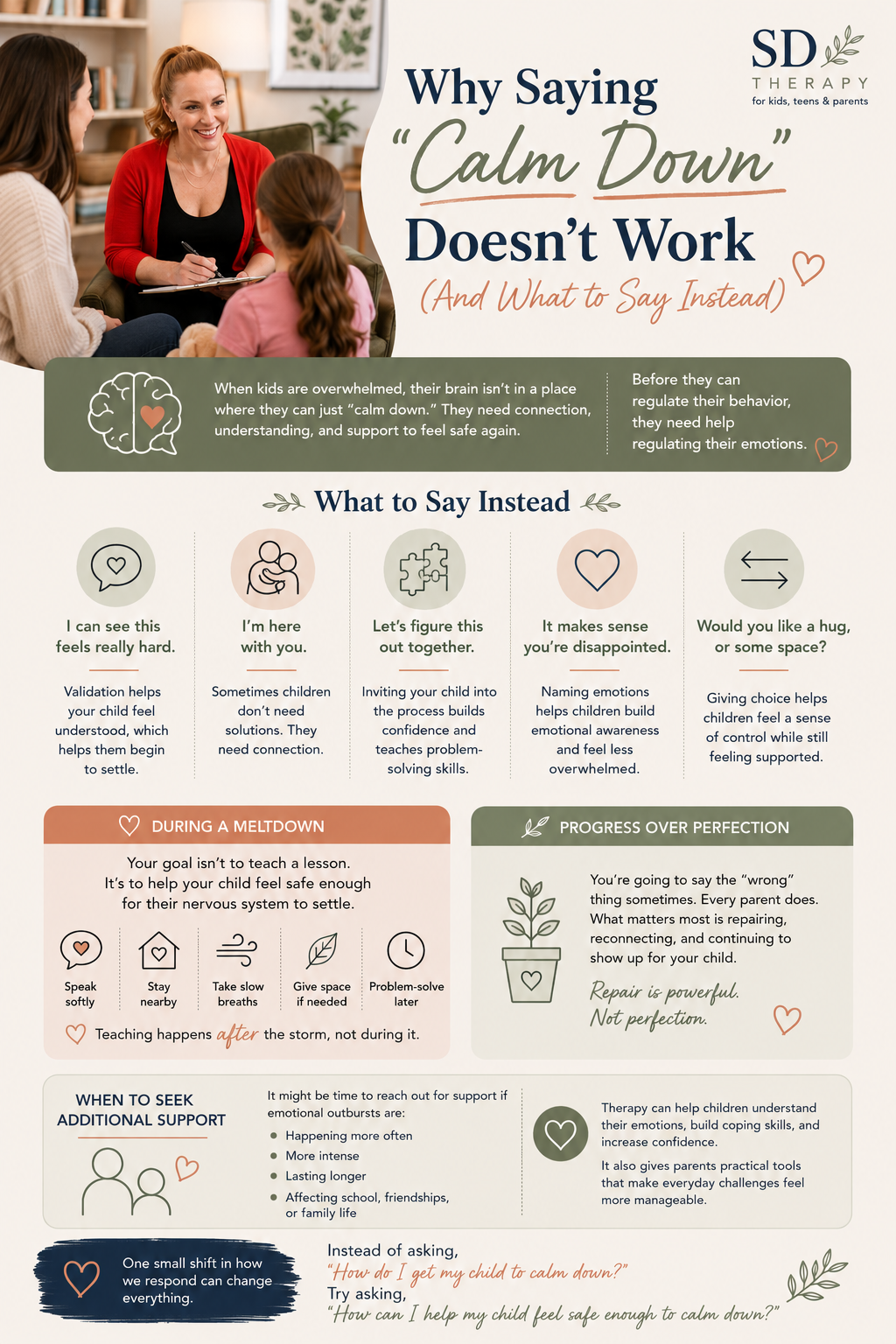

Why Saying "Calm Down" Doesn't Work (And What to Say Instead)
Dr. Lindsay O’Shea helps kids, teens, and parents in San Diego, CA.
If you're a parent, you've probably said it before.
"Calm down."
Maybe you've also tried...
"Take a deep breath."
"You're okay."
"There's nothing to cry about."
You weren't trying to dismiss your child's feelings. You were trying to help.
When our children are overwhelmed, it's natural to want the tears, yelling, or meltdown to stop as quickly as possible. Most of us say these things because we genuinely don't want to see our child hurting.
But here's the challenge:
When a child is overwhelmed by big emotions, their brain isn't in a place where they can simply decide to calm down.
In fact, hearing "calm down" can sometimes have the opposite effect.
Why It Doesn't Work
Think about the last time you were really overwhelmed.
Maybe you were stressed at work, running late, or had a difficult conversation.
Imagine someone looked at you and said...
"Just calm down."
It probably wouldn't make you feel calmer.
It might even make you feel more frustrated because you don't feel understood.
Children experience that same disconnect.
When emotions are running high, they're not choosing to overreact. Their nervous system is overwhelmed.
Before they can regulate their behavior, they need help regulating their emotions.
What Your Child Needs First
When children are dysregulated, they don't need perfect words.
They need to feel safe.
One of the most powerful things you can do is communicate:
"I'm here."
"I can handle this."
"We'll get through it together."
That sense of safety is what helps the nervous system begin to settle.
What to Say Instead
Here are a few phrases I often encourage parents to try.
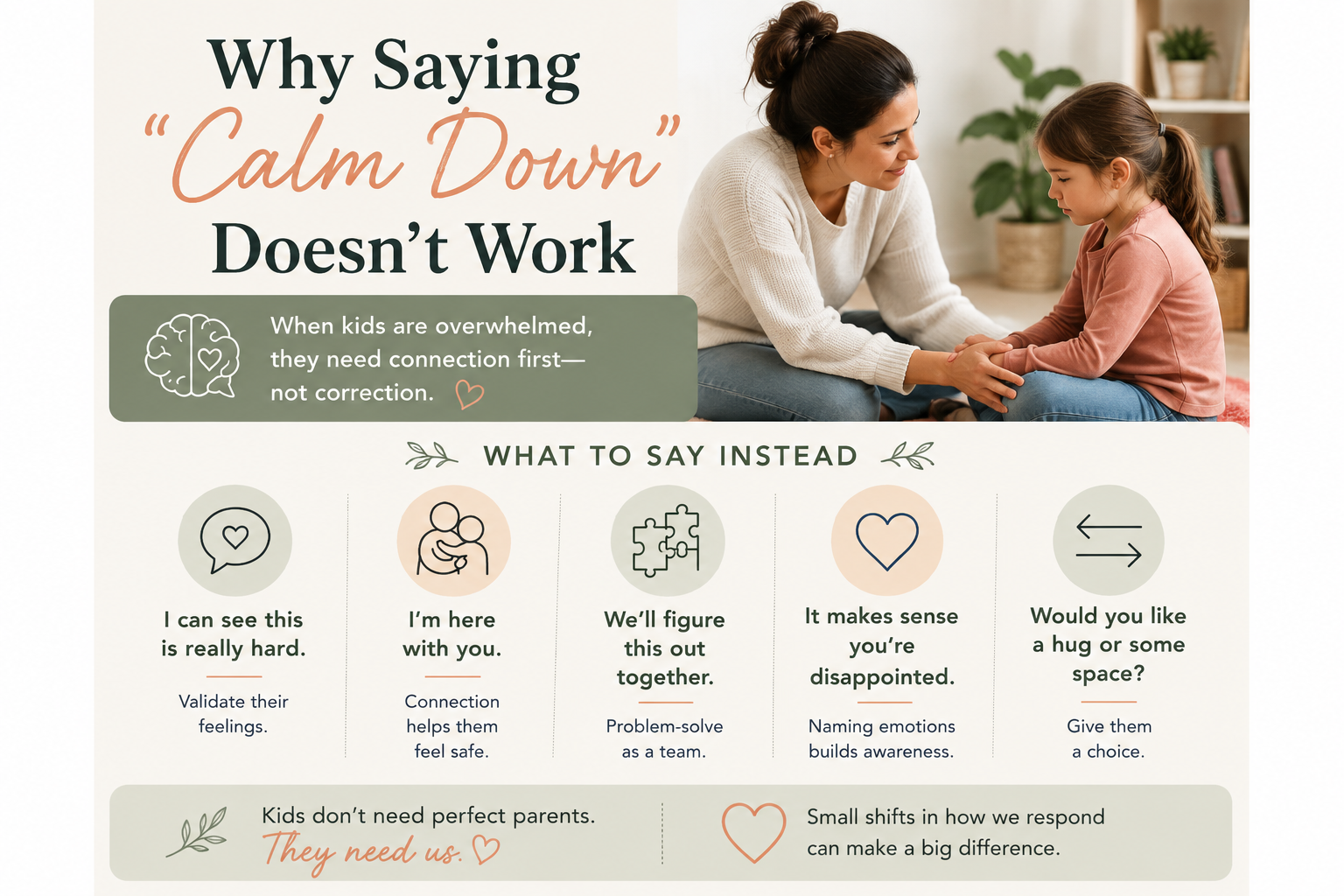
"I can see this feels really hard."
You don't have to agree with your child's reaction to validate their experience.
Validation simply says,
"I see that this is difficult for you."
Feeling understood often helps children settle much faster than trying to convince them they shouldn't be upset.
"I'm here with you."
Sometimes children don't need solutions.
They need connection.
Your calm presence communicates safety in a way that words alone can't.
"Let's figure this out together."
Instead of jumping straight into problem-solving, invite your child into the process.
This helps them learn that difficult feelings are something they can work through—not something they have to avoid.
"It makes sense that you're disappointed."
Helping children name emotions builds emotional awareness.
Over time, children become better at recognizing what they're feeling before emotions become overwhelming.
"Would you like a hug, or would you like some space?"
Not every child regulates the same way.
Giving children an appropriate choice can help them regain a sense of control while still feeling supported.
What About During a Full Meltdown?
One of the biggest misconceptions about parenting is that a meltdown is the moment to teach a lesson.
It's usually not.
When a child is flooded with emotion, they're not in a place to reason, reflect, or problem-solve.
Your job in that moment is simply to help them feel safe enough for their nervous system to settle.
The teaching comes later.
Progress Over Perfection
Here's something I remind parents all the time:
You're going to say the "wrong" thing sometimes.
Every parent does.
You will lose your patience.
You will have moments you wish you could redo.
That's part of being human.
Children don't need perfect parents.
They need parents who are willing to reconnect after hard moments.
Repair is one of the most powerful things we can model.
When Is It More Than Typical Big Feelings?
All children have meltdowns.
But if emotional outbursts are becoming more frequent, more intense, lasting longer, or beginning to affect school, friendships, or family life, it may be a sign that your child needs additional support.
Therapy can help children better understand their emotions, develop healthy coping skills, and build confidence navigating life's challenges.
It also gives parents practical tools they can use at home—because supporting a child through big emotions isn't something anyone is expected to figure out alone.
Final Thoughts
One small shift in how we respond can completely change how a child experiences a difficult moment.
Instead of asking,
"How do I get my child to calm down?"
Try asking,
"How can I help my child feel safe enough to calm down?"
That subtle difference changes everything.