

ADHD vs. Anxiety in Children: How Parents Can Tell the Difference
If your child struggles with focus, emotional outbursts, schoolwork, or restlessness, you may wonder:
Is this ADHD or anxiety?
The answer is sometimes both.
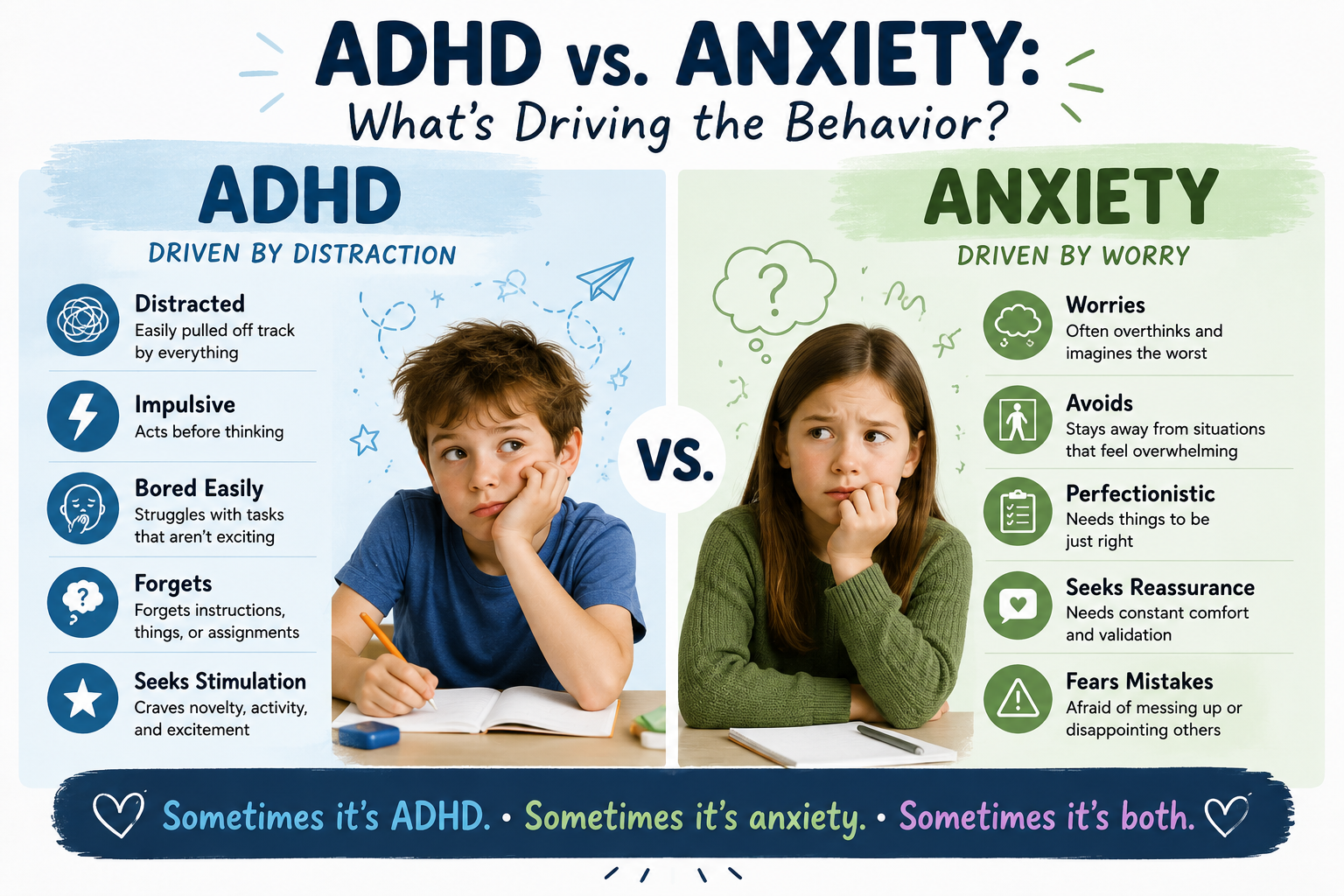
ADHD and anxiety can look surprisingly similar from the outside. Both can cause difficulty concentrating, emotional overwhelm, irritability, and avoidance of challenging tasks. However, the reason behind the behavior is often very different.
A simple way to think about it:
ADHD is driven by distraction.
Anxiety is driven by worry.
Understanding the difference can help parents get the right support for their child.
Why ADHD and Anxiety Are Often Confused
Many parents tell me:
"My child can't focus."
"My child avoids homework."
"My child gets overwhelmed easily."
The challenge is that all of these can happen with ADHD, anxiety, or both.
In fact, anxiety commonly occurs alongside ADHD, making it even harder to know what's really driving the behavior.
The key is to look beyond what your child is doing and ask:
Why are they doing it?
It’s important to note that some children hold it together all day at school and release their emotions once they get home. Learn why this happens in Why Kids Melt Down After School (And Why It Might Actually Be a Good Sign).
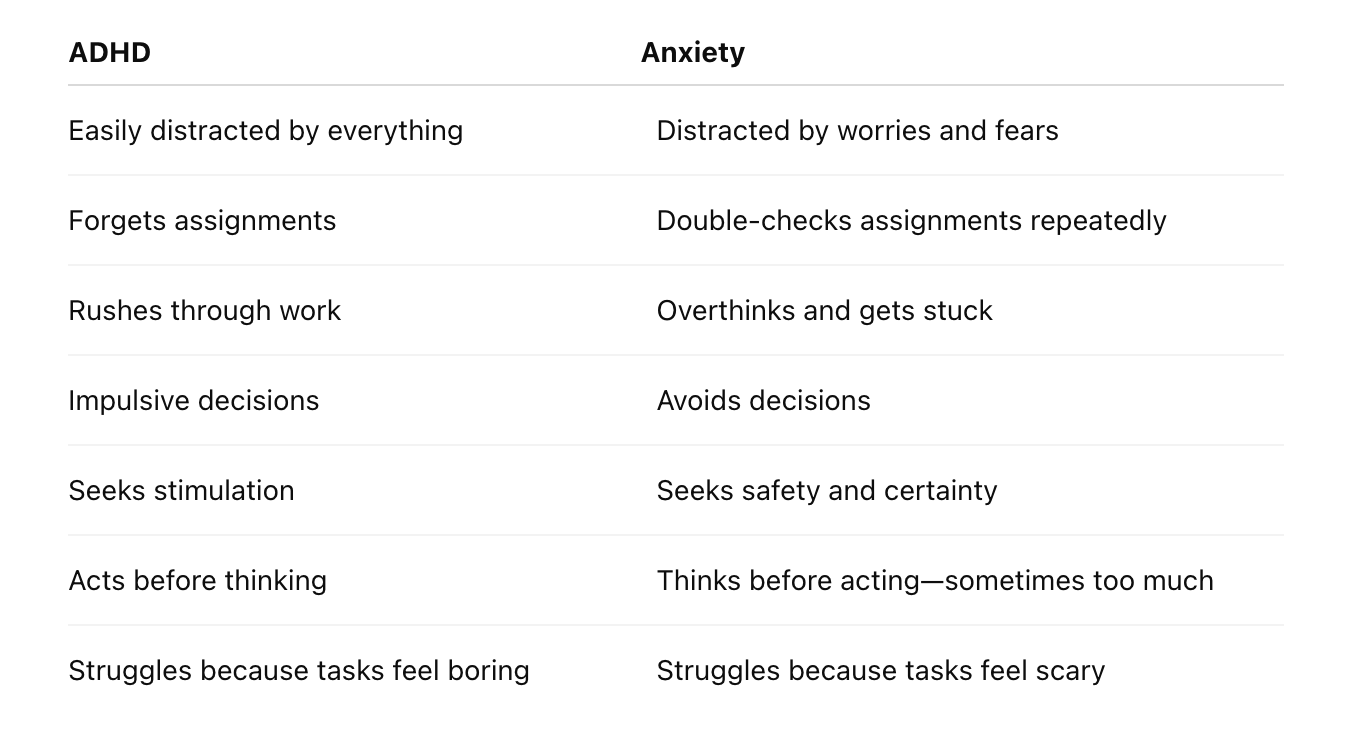
ADHD vs. Anxiety: The Quick Comparison
What ADHD Often Looks Like
Children with ADHD may:
Forget instructions quickly
Lose things frequently
Start tasks but not finish them
Interrupt conversations
Seem constantly in motion
Have trouble organizing themselves
Avoid tasks that require sustained effort
Become frustrated when work feels difficult
A child with ADHD often wants to do the task but struggles to stay engaged long enough to complete it.
Example
You ask your child to clean their room.
Ten minutes later they're:
Playing with Legos
Looking out the window
Petting the dog
Completely forgetting the original task
This is often an attention-regulation problem.
What Anxiety Often Looks Like
Children with anxiety may:
Ask repeated reassurance questions
Worry about making mistakes
Avoid new situations
Complain of stomachaches before school
Struggle with perfectionism
Fear disappointing others
Overthink simple decisions
Have difficulty sleeping due to worry
A child with anxiety often wants to do the task but becomes overwhelmed by fear, uncertainty, or self-doubt.
Example
You ask your child to start homework.
Twenty minutes later they're:
Erasing repeatedly
Asking if they're doing it right
Staring at the paper
Worried they'll get a bad grade
This is often a worry-based problem.
A Parent Tip: Ask One Simple Question
When your child gets stuck, ask yourself:
"Is my child avoiding this because it's boring or because it's scary?"
If the answer is:
"It's boring."
→ ADHD may be playing a larger role.
If the answer is:
"It's scary."
→ Anxiety may be playing a larger role.
This isn't a diagnostic tool, but it can help parents start noticing patterns.
What If My Child Has Both?
Many children do.
A child with ADHD may:
Forget assignments
Fall behind
Receive criticism
Start worrying about failure
Over time, ADHD challenges can contribute to anxiety.
Parents often notice:
ADHD first
Anxiety later
When both conditions are present, treatment typically works best when both are addressed.
Signs It Might Be ADHD
Ask yourself:
✔ Has this been happening for years?
✔ Does it occur at home and school?
✔ Does my child seem driven by distraction?
✔ Does boredom create major problems?
✔ Does my child struggle with organization and follow-through?
If yes, ADHD may be worth exploring.
Many children with ADHD struggle with emotional regulation, which can lead to intense reactions that seem disproportionate to the situation. Learn more about ADHD Emotional Dysregulation: Why Small Problems Cause Big Reactions in Kids.
Signs It Might Be Anxiety
Ask yourself:
✔ Does my child worry excessively?
✔ Do they seek constant reassurance?
✔ Are they afraid of making mistakes?
✔ Do they avoid situations because they feel nervous?
✔ Are physical symptoms showing up (headaches, stomachaches, difficulty sleeping)?
If yes, anxiety may be worth exploring.
When to Seek Professional Help
Consider seeking support if your child's struggles:
Affect school performance
Impact friendships
Create significant family stress
Cause emotional distress
Lead to frequent meltdowns
Interfere with daily functioning
A thorough evaluation can help determine whether ADHD, anxiety, or both are contributing to your child's challenges.
Frequently Asked Questions
Can ADHD look like anxiety?
Yes. Children with ADHD may appear anxious because they struggle with organization, forgetfulness, or repeated negative feedback. These challenges can create genuine worry over time.
Can anxiety look like ADHD?
Yes. Anxiety can make it difficult to concentrate because a child's mind is focused on worries rather than the task in front of them.
Which is more common?
Both are common childhood conditions, and they frequently occur together.
Can a child have ADHD and anxiety at the same time?
Absolutely. Many children experience both ADHD and anxiety, which is one reason accurate assessment is so important.
The Bottom Line
ADHD and anxiety can look very similar from the outside.
The difference is often hidden beneath the behavior.
Children with ADHD are usually struggling with attention regulation, impulsivity, and executive functioning.
Children with anxiety are often struggling with worry, fear, uncertainty, and self-doubt.
The goal isn't to become your child's diagnostician.
The goal is to understand what may be driving their behavior so you can respond with more compassion, confidence, and support.