

Why Do Kids Melt Down After School? (And Why It Might Actually Be a Good Sign)
Your child gets glowing reports from school.
"Great day!"
"Wonderful listener!"
"So helpful!"
Then they get into the car and immediately begin crying because their granola bar broke in half.
Sound familiar?
If your child seems to save their biggest emotions for home, you're not alone.
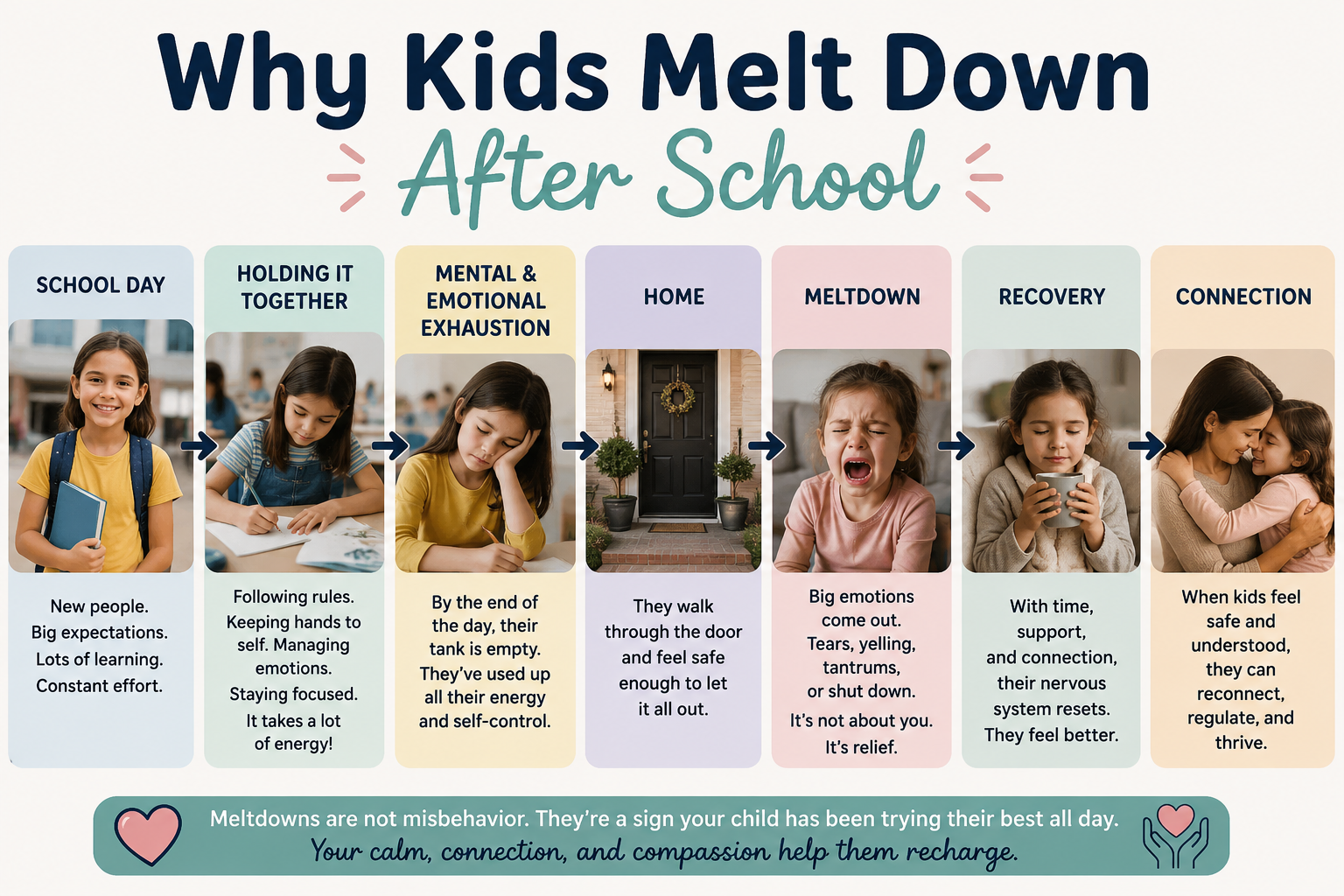
In many cases, what you're seeing is something psychologists often call after-school restraint collapse—a release of all the emotional energy, self-control, stress, and effort your child used throughout the school day.
The good news?
This doesn't usually mean you're doing something wrong.
In fact, it may mean your child feels safe enough with you to finally let their guard down.
The Mystery Every Parent Wants Solved
Many parents ask:
"Why is my child an angel at school and a tornado at home?"
The answer surprises people.
Your child isn't holding it together at school because school is easy.
They're holding it together because school requires an enormous amount of effort.
Think about everything your child is doing all day:
Following directions
Managing emotions
Paying attention
Handling disappointment
Navigating friendships
Tolerating noise
Sitting still
Solving problems
Meeting expectations
That's a lot for a developing brain.
Especially if your child has:
ADHD
Anxiety
Perfectionism
Sensory sensitivities
Learning challenges
By the time they get home, their emotional gas tank may be running on fumes.
For some children, after-school meltdowns are connected to ADHD-related emotional regulation difficulties. Learn more in ADHD Emotional Dysregulation: Why Small Problems Cause Big Reactions in Kids.
The Beach Ball Analogy
Imagine trying to hold a beach ball underwater.
At first, it's manageable.
But the longer you push it down, the harder it becomes.
Eventually...
WHOOSH.
It explodes to the surface.
That's often what happens after school.
Your child has been holding in:
Frustration
Worry
Disappointment
Exhaustion
Social stress
Sensory overload
And home is where it finally comes out.
What After-School Meltdowns Can Look Like
Not every child responds the same way.
Some children:
Cry
Yell
Slam doors
Argue
Others:
Withdraw
Hide in their room
Refuse to talk
Seem unusually irritable
And some children appear completely fine until you ask:
"How was school?"
Then suddenly all bets are off.
Signs Your Child May Be Experiencing After-School Restraint Collapse
✔ Meltdowns happen shortly after school
✔ Teachers report few concerns
✔ Weekends are easier
✔ Small frustrations trigger big reactions
✔ Your child seems exhausted after school
✔ The behavior is most intense at home
✔ Your child struggles more after particularly demanding school days
A Parent Tip You Can Use Today
Stop Asking Questions Immediately
I know.
This feels impossible.
You haven't seen your child all day.
Of course you want to ask:
How was school?
What did you learn?
Did anything happen?
But for some children, especially those with ADHD or anxiety, questions can feel like one more demand.
Try this instead:
The 20-Minute Rule
For the first 20 minutes after school:
✔ Snack
✔ Water
✔ Quiet activity
✔ Connection without conversation
Examples:
Coloring together
Playing catch
Walking the dog
Listening to music
Sitting nearby while they decompress
You may be surprised how much more your child shares once their nervous system settles.
What Parents Accidentally Do That Makes Things Worse
When children are emotionally flooded, their thinking brain goes offline.
This means these common responses often backfire:
❌ "Calm down."
❌ "You're overreacting."
❌ "It wasn't that bad."
❌ Lectures
❌ Interrogation-style questioning
❌ Jumping straight into homework
Instead, try:
✅ "Looks like you had a hard day."
✅ "I'm glad you're home."
✅ "Let's get a snack first."
Simple. Calm. Supportive.
Why ADHD and Anxiety Make This More Common
Parents are often unsure whether their child's struggles are related to ADHD, anxiety, or both. Read ADHD vs. Anxiety in Children: How Parents Can Tell the Difference.
Children with ADHD often spend enormous energy managing:
Attention
Impulses
Frustration
Emotional reactions
Children with anxiety spend enormous energy managing:
Worry
Perfectionism
Social concerns
Fear of mistakes
By the end of the day, both groups can be emotionally depleted.
That's why after-school meltdowns are especially common in children who struggle with ADHD, anxiety, emotional regulation, or perfectionism.
When Should Parents Be Concerned?
Occasional after-school meltdowns are common.
However, consider seeking support if:
Meltdowns are severe or aggressive
Your child seems constantly overwhelmed
School attendance becomes difficult
Anxiety is increasing
Friendships are affected
Family stress is becoming unmanageable
You don't have to wait until things feel impossible.
Early support can help children develop emotional regulation skills before patterns become entrenched.
Frequently Asked Questions
Why does my child behave at school but not at home?
Many children use tremendous energy managing their emotions and behavior at school. Home is where they feel safest, so strong emotions often emerge there.
Is my child manipulating me?
Usually not.
Children experiencing after-school restraint collapse are generally overwhelmed, not manipulative.
Is this more common with ADHD?
Yes. Children with ADHD often use significant energy regulating attention, behavior, and emotions throughout the school day.
Should I make my child do homework immediately after school?
For many children, a short period of decompression first can improve cooperation and emotional regulation.
The Bottom Line
If your child falls apart after school, it doesn't necessarily mean school is a disaster.
It doesn't mean you're failing.
And it doesn't mean your child is trying to make your life difficult.
Sometimes it means they've been working incredibly hard all day.
The child who melts down over a broken granola bar may be the same child who spent seven hours trying their absolute best.
The goal isn't to stop every emotion.
The goal is helping your child feel safe enough to recover, recharge, and learn healthier ways to navigate big feelings.
And sometimes, that starts with a snack and twenty minutes of peace.