

Anxiety and Perfectionism in Kids: When Doing Their Best Starts to Hurt
Your child gets a 98%.
And somehow they're upset.
They score the winning goal.
But spend the entire car ride talking about the one mistake they made.
They erase the same sentence six times.
Refuse to turn in an assignment because it's "not good enough."
Or completely avoid trying something new because they might not be perfect at it.
If this sounds familiar, your child may not simply be a high achiever.
They may be struggling with anxiety-driven perfectionism.
And despite what many people think, perfectionism isn't usually about confidence.
It's often about fear.
What Perfectionism Really Looks Like
Many parents picture perfectionism as:
✔ Straight A's
✔ Excellent behavior
✔ Hard work
✔ High standards
Sometimes that's true.
But perfectionism often looks more like:
Tears over small mistakes
Fear of getting answers wrong
Meltdowns during homework
Avoiding challenges
Constant reassurance-seeking
Being incredibly hard on themselves
The child isn't striving for excellence.
They're trying to avoid failure.
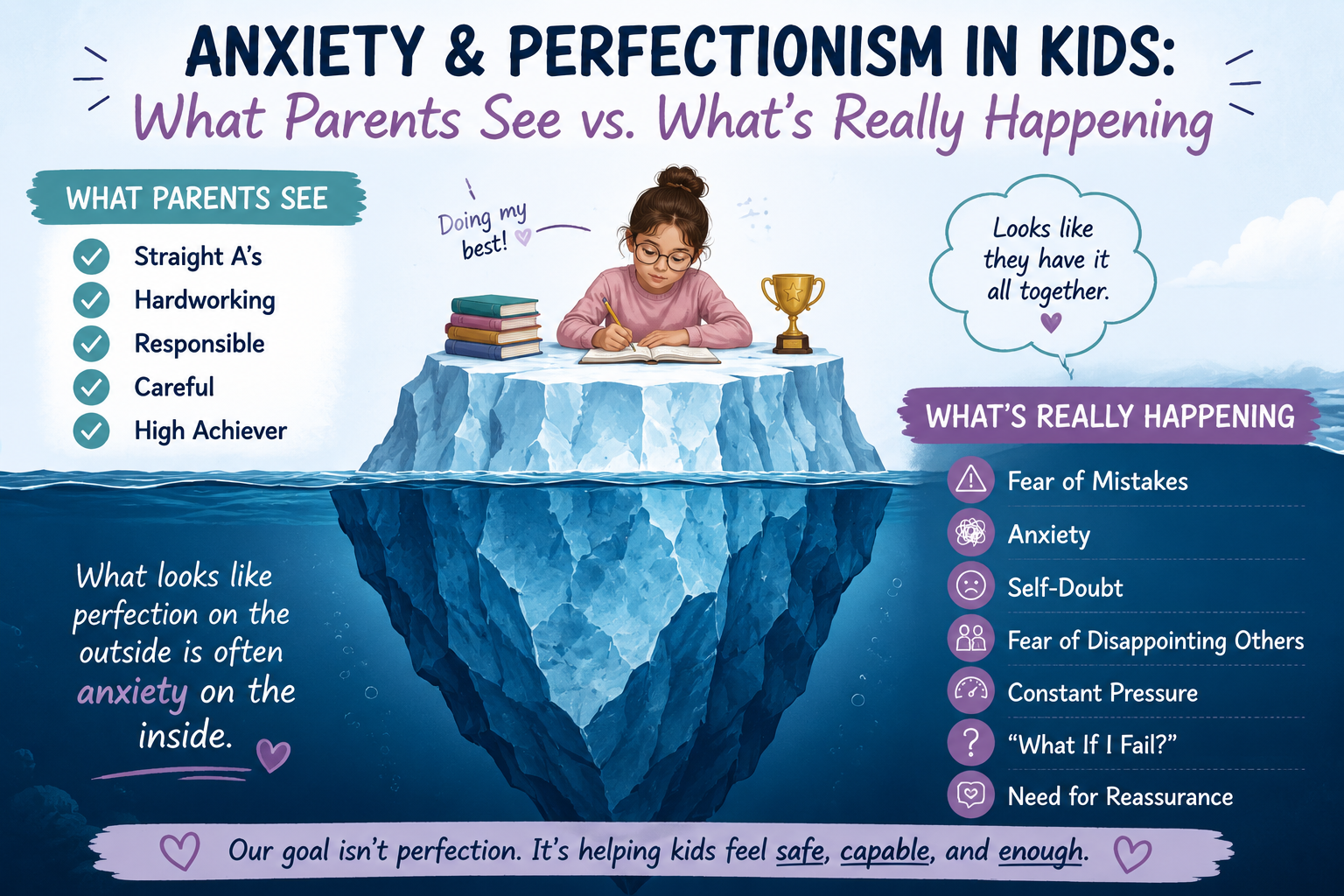
The Iceberg Parents Don't See
Above the Surface
Responsible
Hardworking
Careful
Mature
High-achieving
Below the Surface
Worry
Self-doubt
Fear of mistakes
Anxiety
Pressure
Fear of disappointing others
What looks like motivation from the outside may actually be anxiety underneath.
Perfectionism is often driven by anxiety, but ADHD can also contribute to overwhelm and self-criticism. Read ADHD vs. Anxiety in Children: How Parents Can Tell the Difference.
7 Signs Anxiety May Be Driving Your Child's Perfectionism
1. They Melt Down Over Small Mistakes
The spelling error.
The missed soccer shot.
The crooked drawing.
To adults, these feel minor.
To a perfectionistic child, they can feel enormous.
Mistakes aren't simply mistakes.
They feel like proof that something is wrong with them.
2. They Avoid Things They're Not Good At
This one surprises parents.
You'd think perfectionists try everything.
Actually, many avoid new experiences entirely.
Why?
Because if they don't try, they can't fail.
You may hear:
"I don't want to."
"It's stupid."
"I'm not interested."
Sometimes what they're really saying is:
"I'm afraid I won't be good at it."
3. Homework Takes Forever
A 20-minute assignment somehow becomes a two-hour ordeal.
Not because they don't understand the material.
Because they:
Recheck everything
Rewrite answers
Start over repeatedly
Get stuck on details
Perfectionism often slows children down considerably.
4. They Ask for Constant Reassurance
"Did I do okay?"
"Are you mad at me?"
"Was that right?"
"Do you think my teacher liked it?"
The reassurance helps temporarily.
But anxiety usually comes back quickly.
Then they need reassurance again.
And again.
And again.
5. They Procrastinate
This seems backwards.
Parents often assume perfectionists are super organized.
Not always.
Many perfectionistic kids procrastinate because the pressure to do something perfectly feels overwhelming.
If they can't do it perfectly...
They'd rather not start at all.
6. They Are Incredibly Hard on Themselves
You hear things like:
"I'm so stupid."
"I can't do anything right."
"Everyone else is better than me."
The child who appears successful on the outside may be fighting a constant internal battle on the inside.
7. Nothing Ever Feels Good Enough
The goalpost keeps moving.
A good grade isn't enough.
A great performance isn't enough.
Success provides relief for about five minutes.
Then the anxiety finds something else to worry about.
A Parent Tip You Can Use Tonight
Stop Praising Results. Start Praising Effort.
Instead of:
❌ "You're so smart."
❌ "You're the best."
❌ "Perfect!"
Try:
✅ "You worked really hard on that."
✅ "I noticed you kept trying."
✅ "That looked challenging and you stuck with it."
Research and child development experts consistently recommend focusing on effort, persistence, and courage rather than outcomes alone. This helps build resilience and a growth mindset instead of fear of failure.
What Parents Accidentally Do That Makes It Worse
Without realizing it, loving parents sometimes reinforce perfectionism by:
Constantly correcting mistakes
Overemphasizing grades
Comparing siblings
Rushing in to prevent failure
Praising outcomes more than effort
Children often absorb the message:
"I am valued when I perform."
Even when that's not what parents intend.
The Goal Isn't Lower Standards
This is important.
We're not trying to raise children who don't care.
We're trying to raise children who can:
Make mistakes
Learn from setbacks
Take healthy risks
Try new things
Recover from disappointment
The goal isn't perfection.
The goal is resilience.
When Should Parents Seek Support?
Consider seeking support if perfectionism is causing:
Significant anxiety
Emotional outbursts
School avoidance
Difficulty sleeping
Frequent reassurance-seeking
Declining self-esteem
Avoidance of challenges
Perfectionism becomes concerning when it starts interfering with your child's happiness, relationships, learning, or daily life.
Frequently Asked Questions
Is perfectionism a form of anxiety?
Not always. However, anxiety and perfectionism are often closely connected. Many children use perfectionism as a way to reduce uncertainty, avoid mistakes, or prevent criticism.
Can perfectionism affect school performance?
Yes. While some children achieve highly, others procrastinate, avoid assignments, or become overwhelmed by the pressure they place on themselves.
Why does my child get so upset over small mistakes?
For perfectionistic children, mistakes can feel emotionally threatening. They often connect mistakes with self-worth, disappointment, or fear of failure.
Can therapy help with perfectionism?
Yes. Therapy can help children develop healthier coping skills, challenge unrealistic expectations, build emotional resilience, and reduce anxiety around mistakes and performance.
The Bottom Line
The child who cries over a missed homework question isn't being dramatic.
The child who refuses to try unless they're certain they'll succeed isn't being stubborn.
The child who gets a 98% and focuses on the missing two points isn't ungrateful.
Often, they're anxious.
And underneath the perfectionism is a child who desperately wants to feel safe, accepted, and good enough.
The good news?
Children don't need to learn how to be perfect.
They need to learn that they don't have to be.