

School Anxiety in Children and Teens: Signs Parents Shouldn't Ignore
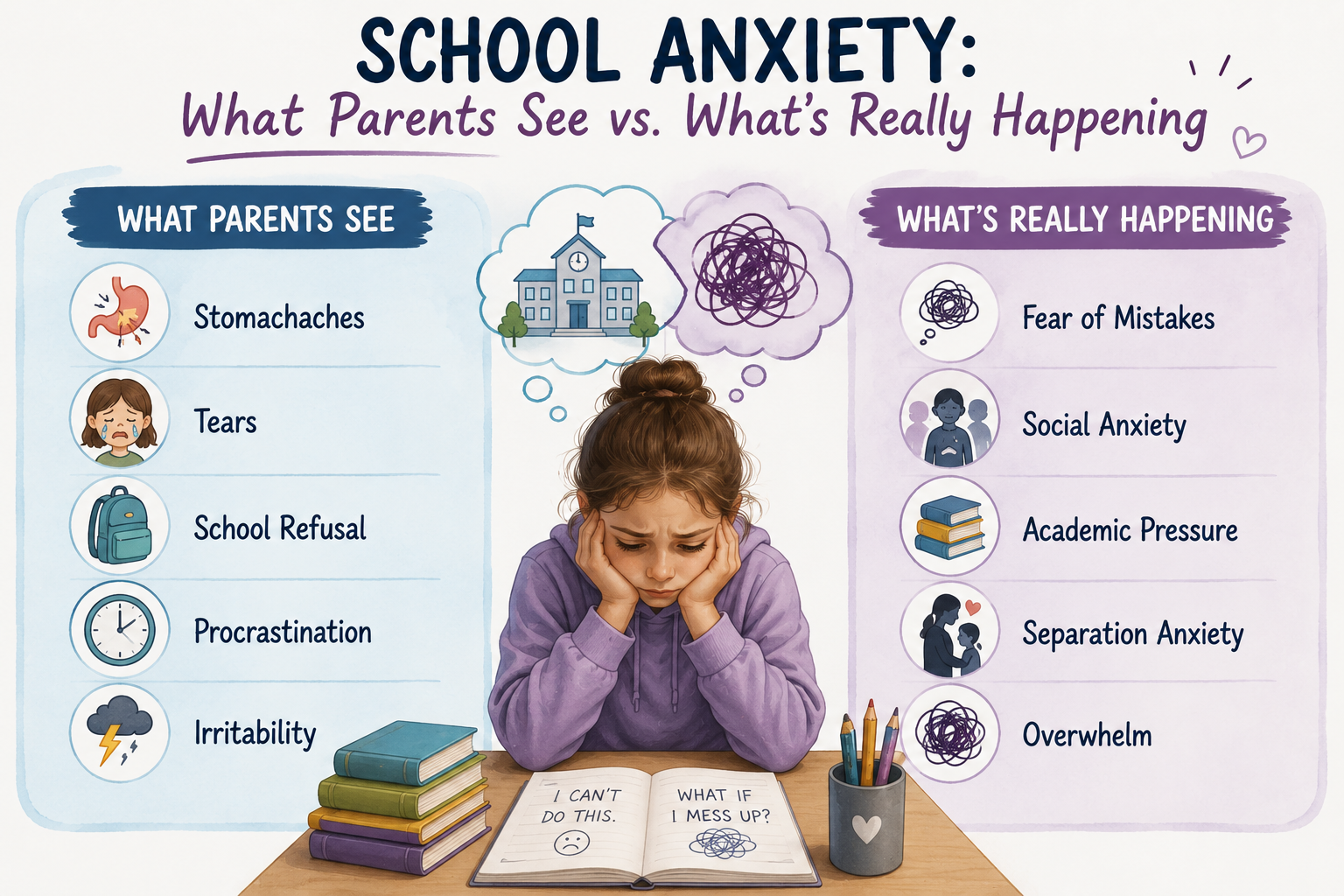
Your child wakes up every morning with a stomachache.
They suddenly hate school.
Homework has become a battle.
The school nurse knows them by name.
And somehow every symptom magically improves by Saturday morning.
If this sounds familiar, your child may be struggling with school anxiety.
And despite what many parents worry about, school anxiety is usually not about laziness, manipulation, or a lack of motivation.
More often, it's a child whose nervous system is sounding an alarm.
The challenge is figuring out why.
What Is School Anxiety?
School anxiety occurs when a child experiences significant worry, fear, stress, or emotional distress related to school.
Sometimes the anxiety is obvious.
Your child tells you:
"I don't want to go."
"I hate school."
"I'm nervous."
Other times, anxiety is much sneakier.
Instead of saying they're anxious, children may complain of:
Stomachaches
Headaches
Nausea
Fatigue
Trouble sleeping
Irritability
Many parents spend weeks trying to solve a medical mystery before realizing anxiety may be part of the picture.
The Morning Mystery
Parents often describe a very specific pattern:
7:00 AM:
"My stomach hurts."
7:15 AM:
"I don't think I can go to school."
7:30 AM:
Tears.
Panic.
Negotiations.
Desperation.
Saturday morning:
Perfectly fine.
Coincidence?
Usually not.
Anxiety often shows up most strongly when children anticipate the thing they fear.
Signs of School Anxiety in Children and Teens
Many children work incredibly hard to manage anxiety during the school day and release those emotions once they get home. Learn why in Why Kids Melt Down After School (And Why It Might Actually Be a Good Sign).
Emotional Signs
Frequent worry about school
Increased irritability
Emotional outbursts
Clinginess
Fear of making mistakes
Crying before school
Physical Signs
Stomachaches
Headaches
Nausea
Fatigue
Difficulty sleeping
Behavioral Signs
School refusal
Frequent visits to the nurse
Avoiding homework
Procrastination
Reassurance-seeking
Difficulty separating from parents
School Anxiety Doesn't Always Look Like Anxiety
This is where parents often get confused.
Sometimes school anxiety looks like:
Anger
Your child explodes every morning.
Perfectionism
Your child spends three hours on a 20-minute assignment.
ADHD
Your child struggles to focus because their brain is consumed by worry.
Sometimes parents aren't sure whether they're seeing anxiety, ADHD, or a combination of both. Read ADHD vs. Anxiety in Children: How Parents Can Tell the Difference to better understand the overlap.
Avoidance
Your child insists they don't care.
In reality, they may care very deeply.
Sometimes too much.
What's Actually Making School Feel So Hard?
School anxiety isn't one thing.
It can stem from many different concerns.
Fear of Making Mistakes
Children worry about:
Getting answers wrong
Looking embarrassed
Disappointing teachers
For many children, school anxiety is closely connected to perfectionism. They may worry about getting answers wrong, disappointing teachers, or making mistakes in front of classmates. Learn more in Anxiety and Perfectionism in Kids: When Doing Their Best Starts to Hurt.
Social Anxiety
Children worry about:
Friendships
Being judged
Speaking in class
Academic Pressure
Children worry about:
Grades
Tests
Falling behind
Separation Anxiety
Children struggle being away from caregivers.
ADHD-Related Challenges
Children may worry because school consistently feels harder than it does for peers.
A Parent Tip You Can Use Tomorrow Morning
Stop Reassuring. Start Validating.
This surprises many parents.
When children are anxious, parents naturally say:
❌ "You'll be fine."
❌ "Don't worry."
❌ "There's nothing to be scared of."
The problem?
Anxiety rarely listens to logic.
Instead try:
✅ "I can see this feels really hard right now."
✅ "Your brain is telling you something scary might happen."
✅ "We'll get through this together."
Validation helps children feel understood without accidentally reinforcing anxiety.
What Parents Accidentally Do That Makes School Anxiety Worse
With the best intentions, parents sometimes:
Allow unlimited avoidance
Provide endless reassurance
Rescue children from discomfort
Focus only on attendance
The goal isn't forcing a child through anxiety.
The goal is helping them build confidence that they can handle it.
School Anxiety vs. School Refusal
These terms are often used interchangeably, but they're not exactly the same.
School Anxiety
The emotion.
The worry.
The fear.
School Refusal
The behavior.
The avoidance.
The inability to attend school consistently.
Many children experience school anxiety without refusing school.
Others develop school refusal when anxiety becomes overwhelming.
When Should Parents Be Concerned?
Consider seeking support if your child:
Frequently complains of physical symptoms before school
Experiences significant distress related to school
Has increasing emotional outbursts
Shows signs of anxiety or depression
Is missing school regularly
Is struggling socially or academically
The earlier anxiety is addressed, the easier it is to prevent it from becoming more entrenched over time.
If school anxiety is affecting your child's emotional well-being, friendships, academics, or daily functioning, Child Anxiety Therapy or Teen Anxiety Therapy can help children build confidence, develop coping skills, and learn to manage anxiety more effectively.
Frequently Asked Questions
Is school anxiety normal?
Many children experience occasional nervousness about school. School anxiety becomes concerning when it significantly impacts attendance, emotional well-being, friendships, learning, or daily functioning.
Can school anxiety cause physical symptoms?
Yes. Anxiety frequently shows up physically in children. Stomachaches, headaches, nausea, fatigue, and difficulty sleeping are all common symptoms.
Is my child being manipulative?
Usually not.
Children struggling with school anxiety are generally trying to avoid emotional distress, not trying to control their parents.
Can ADHD cause school anxiety?
Yes. Children with ADHD may develop anxiety when school feels consistently challenging, overwhelming, or frustrating.
Will my child outgrow school anxiety?
Some children improve over time, but persistent anxiety often benefits from support, skill-building, and intervention rather than waiting for it to disappear on its own.
The Bottom Line
The child who says they hate school isn't always trying to avoid learning.
The child with daily stomachaches isn't always sick.
The child who melts down every morning isn't always being difficult.
Sometimes they're anxious.
And sometimes that anxiety is asking for help in the only way they know how.
When parents learn to look beneath the behavior, they often discover something important:
The problem isn't that their child won't go to school.
The problem is that something about school doesn't feel safe, manageable, or predictable to them.
And that's a problem that can be understood, supported, and treated.